

How to design a functional kitchen
The rules to know before renovating
You dream of a new kitchen and you probably already have a good idea of the style you like.
The color of the cabinets is chosen. You have saved your favorite counter. Maybe you even know which appliance you want.
But will your kitchen really be functional?
This is often where things get complicated.
Une cuisine peut être magnifique sur une photo et devenir frustrante au quotidien simplement parce que quelques dimensions, dégagements ou détails techniques ont été négligés.
At Atelier C3 Design, we often repeat it: a beautiful kitchen is good. A beautiful kitchen that really works is even better.
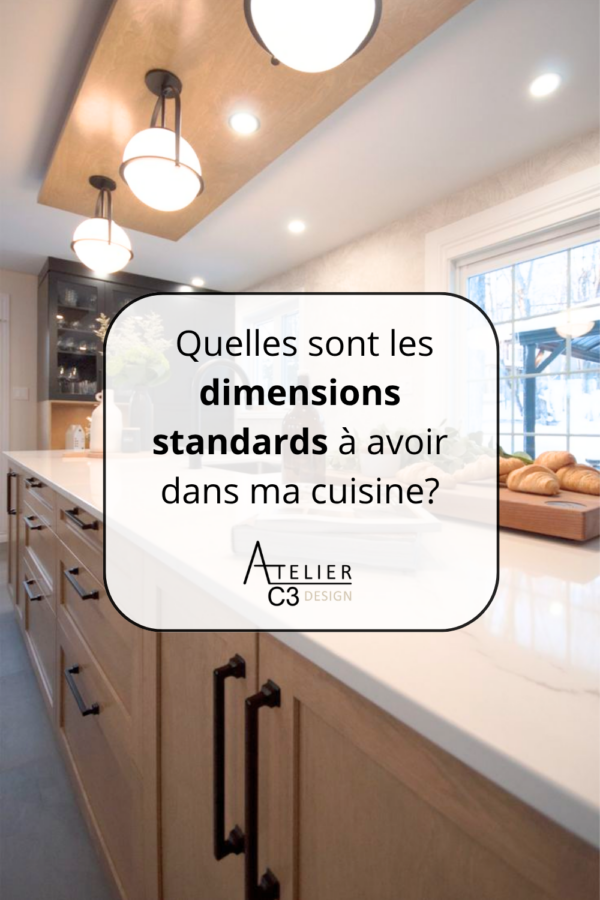
A kitchen is thought of in inches
A few inches may seem insignificant on a plane.
Yet, they can completely change your experience once the kitchen is installed.
Too narrow traffic, a cabinet door that conflicts with another, a refrigerator that sticks out more than expected or stools that block the passage around the island are problems that unfortunately are often discovered too late.
That is why designers work with different reference dimensions to design a kitchen.
But knowing the dimensions is only part of the job.
Above all, you need to know which ones to use depending on your space and way of life.
In our online training, we show you the important dimensions to know and how to apply them to your own kitchen.
Your kitchen should be designed around you
For a long time, there was much talk about the famous “work triangle” between the refrigerator, the sink and the cooking area.
That’s another interesting principle.
But the kitchens have changed.
Today, we sometimes cook together, the children sit on the island, we want a coffee corner, a larger pantry, several small appliances and sometimes even a second preparation area.
So the real question becomes:
How do you use your kitchen?
A family with three children will not necessarily have the same needs as a couple who receive regularly.
Your kitchen should be designed around your daily life, not just around a trend.
The mistake we often see: choosing appliances too late
Fridge, stove, hob, built-in oven, dishwasher, extractor hood…
They all seem to have relatively standard dimensions.
But be careful.
Two devices that appear to be the same size may require completely different clearances or installations.
And once the cabinets are ordered, a small mistake can become very costly.
That is why the technical data sheets for appliances are much more important than one might think.
In our training, we show you what to look for before finalizing your plan in order to avoid some unpleasant surprises at the time of installation.
The island: bigger is not always better
This is probably one of the most requested elements in the kitchens we design in Quebec.
It’s where we cook, where we eat, where the children do their homework and guests almost always end up settling in while we prepare dinner.
But wanting a huge island can sometimes damage the functionality of the kitchen.
Before determining its dimensions, several questions must be asked:
Do we want to eat there?
How many people should be able to sit there?
Do we add a sink?
Tidying up?
A baking sheet?
And above all: will there still be enough space to move around comfortably?
It is the balance between all these decisions that makes it possible to create a truly functional island.
Storage: think about what you really use
A beautiful pantry full of shelves is not necessarily a well-designed pantry.
Same thing for a kitchen filled with cabinets.
The amount of storage is important, but its location is even more so.
Ask yourself a few questions:
Where do you make your coffee in the morning?
Where do you want to put the toaster?
The cauldrons?
The large hobs?
The children’s lunches?
Recycling?
It is these small daily habits that should influence the design of your kitchen.
A good kitchen almost makes you forget that it was designed: everything just seems to be in the right place.
The materials and maintenance in all that?
Once the feature is set comes probably the most fun part: create your mood.
Wood, melamine, polymer, stone, quartz, porcelain, ceramic…
The possibilities are enormous.
But rather than selecting each material individually just because you like it, think of your kitchen as a whole, while considering the level of maintenance you want on a daily basis.
The counter must work with the cabinets.
The cabinets with the floor.
The floor with the paint.
And all of these things should work with your home’s natural light.
It is this global vision that allows to create a harmonious, practical and easy-care kitchen, rather than a simple accumulation of beautiful materials.
A mistake on paper costs much less than an error on site
This is probably one of the most important things to remember before starting your renovation.
Take time to plan.
A kitchen involves several stakeholders: cabinetmaker, contractor, electrician, plumber, counter supplier, installer and sometimes several others.
A decision made too quickly at the beginning can have consequences several weeks later.
A good plan therefore allows not only to create a more beautiful kitchen, but also to greatly reduce improvisations during the work.
Do you want to design your own kitchen? We’ll show you how.
You like design and you want to actively participate in your renovation?
That’s exactly why we created our online training Atelier C3 Design.
Our goal is to give you a part of our working method so that you can think about your kitchen as a designer would.
We go much further than Pinterest inspiration.
You will discover the important dimensions to know, the principles of circulation, the planning of appliances, the island, storage, materials and several details that are not necessarily thought of when renovating for the first time.
the goal?
Allow you to make better decisions before ordering your materials or starting work.
Because a successful kitchen doesn’t start with the color of the cabinets.
She starts with a good plan.